


The End of Google's Privacy Sandbox
[Grow by DPG Media] Simon Harris on the implications of Google's change of course for adtech
Google has been under fire for the past seven days. On April 17, a US judge ruled that Google has knowingly acquired and maintained a monopoly position in the adtech market. Four days later, the assessment phase of the Google Search lawsuit began, in which it was determined that Google also has a monopoly here. And on April 22, Google halted their Privacy Sandbox initiative. The Privacy Sandbox is a set of tools and APIs that were intended to replace third-party cookies in their Chrome browser. Simon Harris , Director Ads Strategy at DPG Media, takes you through the developments in this article by Grow van DPG Media .
What happened?
Google has decided to “maintain its current approach to offering third-party cookie choices to users in Chrome and will not roll out a new, separate user choice interface for third-party cookies.”
Additionally, Google stated, “Users can continue to choose the best option for themselves in Chrome's privacy and security settings,” as shown in the settings below.
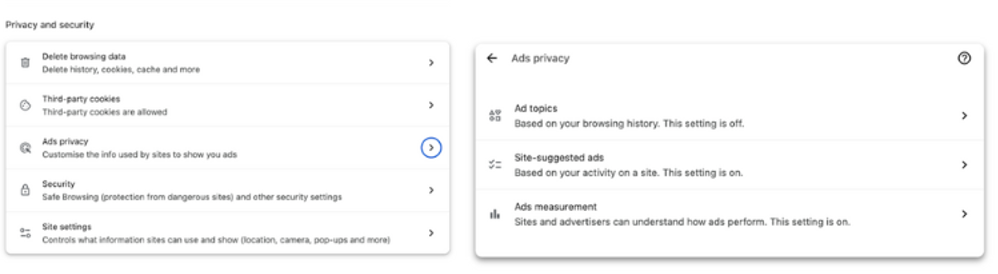
They also said they “will continue to work with the ecosystem to determine how these technologies can best support the industry and consumers.”
In reality, most users do not adjust their cookie settings, even if the Privacy Sandbox tools are left enabled by default. Because cookies outperform the Sandbox (more on that below), it is unlikely that the digital advertising industry will be motivated to use the Sandbox tools as long as the current cookie situation persists.
The Privacy Sandbox was first announced in August 2019. Google’s stated goal was to improve user privacy while supporting a free and open internet ecosystem. But development has been painfully slow and controversial.
In January 2021, the UK Competition Authority (CMA) announced it would launch an investigation into whether the Privacy Sandbox would harm competition in the digital advertising market. Since then, the rollout has been delayed four times:
First Delay (June 2021): The phaseout of third-party cookies was pushed back to 2023 to allow more time for testing and to address concerns from regulators and industry stakeholders.
Second Delay (July 2022): The schedule was pushed back to the second half of 2024, with Google citing the need for further testing and feedback.
Third Delay (April 2024): Struggling to balance privacy and competition concerns, Google again delayed the rollout, this time to early 2025, to allow time for evaluation and resolution of remaining issues.
Change in Approach (July 2024): Google announced that it would no longer automatically block third-party cookies. Instead, users would be given the option to enable or disable cookies, scrapping the original plan to remove them entirely.
Since this change of course, there has been little public commentary on user choice or the ongoing issues surrounding the Privacy Sandbox. What we do know is that performance was very poor, as can be seen in these results.
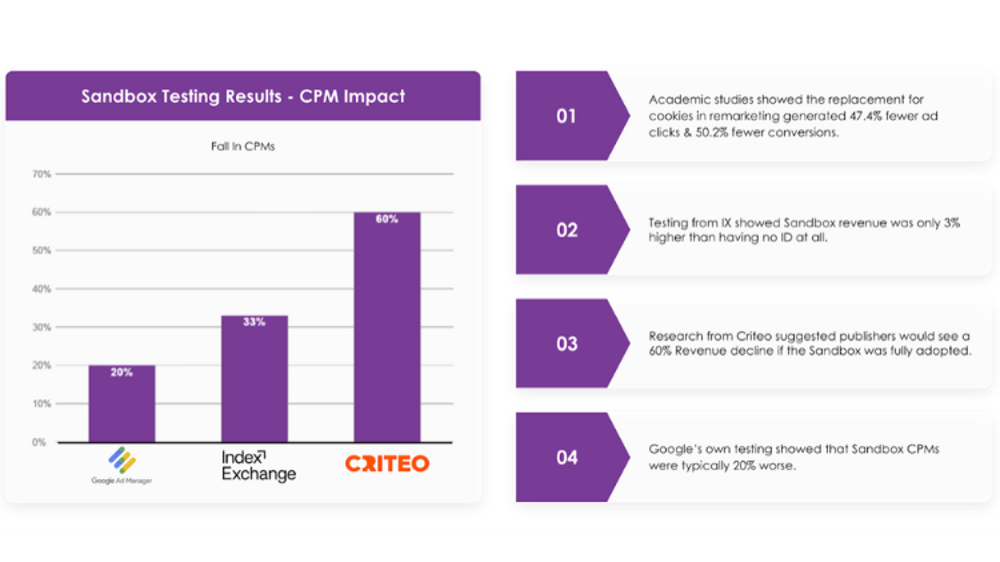
Some say Google has struggled to balance competing demands. On the one hand, there’s the need for better performance, which would alleviate competition concerns and satisfy the CMA. On the other, there’s pressure from other regulators, such as the UK’s Information Commissioner’s Office (ICO), to develop tools that improve user privacy.
To complicate matters, Google is facing two major monopoly cases. The first is the Google Search lawsuit in the US, where one of the proposed remedies is the possibility of spinning off Chrome entirely, as the browser accounts for 35 percent of all searches on Google and generates billions in search revenue. The second case, the AdTech lawsuit, successfully proved last week that Google has established and maintained a monopoly.
What happens now?
It remains to be seen what happens in the antitrust cases and how it impacts the advertising and browser ecosystem. They may also regret the time and effort invested in Google’s Privacy Sandbox, as it is unlikely to have the impact that many predicted in 2019. What role will the Sandbox play in digital marketing after this consultation takes place?
 Follow Marketing Report on LinkedIn
 Subscribe to the Marketing Report Newsletter
 Send us your press releases, columns, interviews…
Join Marketing Report in our LinkedIn Groups


