![[Column] Michiel Frackers: Jeff Bezos' Amazon investigates Perplexity of ... Jeff Bezos](Article Images/Key Persons/Michiel_Frackers_Marketing_Report.jpg)
[Column] Michiel Frackers: Jeff Bezos' Amazon investigates Perplexity of ... Jeff Bezos
1. Grand Theft AI
To write this newsletter, I take notes during the week about topics that interest me. On Saturday, I ask four AI search engines to rank them in order of relevance: ChatGPT from OpenAI, Gemini from Google, Claude from Anthropic, and Perplexity , from Grand Theft AI .
At least, that's what The Verge calls the creators of Perplexity, apparently committing systematic plagiarism:
“Perplexity is essentially a profit-seeking middleman on high-quality sources. The original value of search engines was that by aggregating the work of journalists and others, the results from Google, for example, drove traffic to those sources.
But by providing an answer instead of referring people to a primary source, these so-called “answer engines” are taking away the primary source, advertising revenue, and keeping that revenue for themselves. Perplexity is one of a group of vampires that includes Arc Search and Google itself.
But Perplexity has gone a step further with its Pages product, which creates a summary report based on those primary sources. It’s not just quoting a sentence or two to directly answer a user’s question – it creates a fully aggregated article, and it’s accurate in the sense that it actively plagiarizes the sources it uses.
Forbes discovered that Perplexity bypassed the publication's paywall to summarize an investigation the publication conducted into former Google CEO Eric Schmidt's drone company.”
So Perplexity steals the copyrighted work of journalists. Reason for Wired to start an investigation that was summarized with the headline: “ Perplexity is a bullshit machine .”
Forbes has a neat summary of the firestorm surrounding Perplexity’s theft. According to Reuters, Perplexity isn’t the only AI company whose business model is stealing and selling other people’s information, but there’s still reason to ask Perplexity itself what’s going on. So I asked it this question:
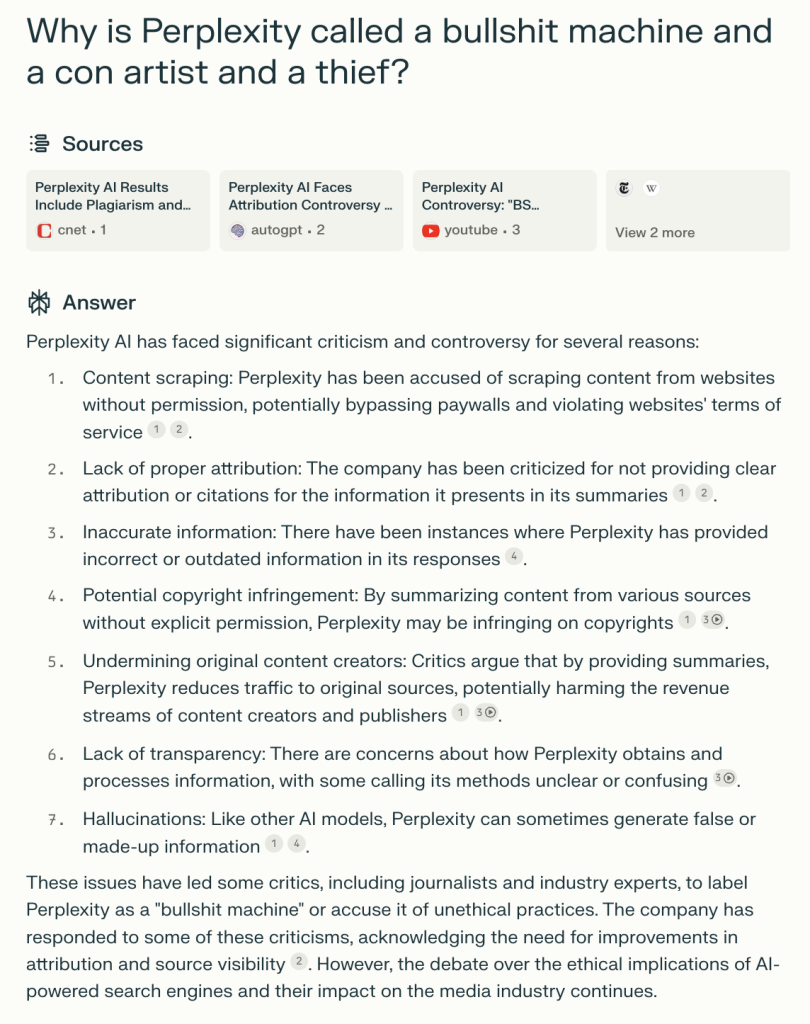
That's a clear answer, even with a neat source reference above the answer.
Jeff Bezos' Amazon Investigates Jeff Bezos' Perplexity
The funny thing is that AWS, the hosting branch of Amazon, has launched an investigation into Perplexity's practices. Because like many AI companies, Perplexity runs on AWS servers, perhaps also because it is co-financed by Amazon's founder and major shareholder: Jeff Bezos.
“AWS’s Terms of Service prohibit abuse and illegal activity, and our customers are responsible for complying with those terms,” Amazon said, but in practice it may not be that bad because Bezos will never allow his own investment in Perplexity to be killed by Amazon.
2. MIT pioneer finds generative AI overrated
MIT Professor Emeritus of Robotics Rodney Brooks thinks Generative AI, the type of AI based on Large Language Models (LLMs) like Perplexity and ChatGPT, is impressive technology, but perhaps not as capable as many suggest. “I’m not saying LLMs aren’t important, but we have to be careful about how we evaluate them,” Brooks told TechCrunch .
He says the problem with Generative AI is that while it is perfectly capable of performing a given set of tasks, it cannot do everything a human can, and people tend to overestimate its capabilities.
“When a human sees an AI system performing a task, they immediately generalize to things that are similar and make an estimate of the AI system’s competence; not just its performance on that task, but its competence around it,” Brooks said. “And they tend to be very overoptimistic, and that’s because they’re using a model of a human’s performance on a task.”
He added that the problem is that generative AI is not human or even human-like, and it is wrong to attribute human capabilities to it. Brooks’ view is consistent with analyses by Martin Peers and Jenn Zhu Scott, which I wrote about earlier this month .
Incidentally, Brooks is no stranger to some self-reflection: on his own blog he keeps track of the accuracy of his own predictions . Including a self-invented color system, very interesting.
3. Applications for Solana ETFs
On Thursday and Friday, applications were filed for permission from US financial authorities to launch exchange-traded funds ( ETFs ) for the cryptocurrency Solana .
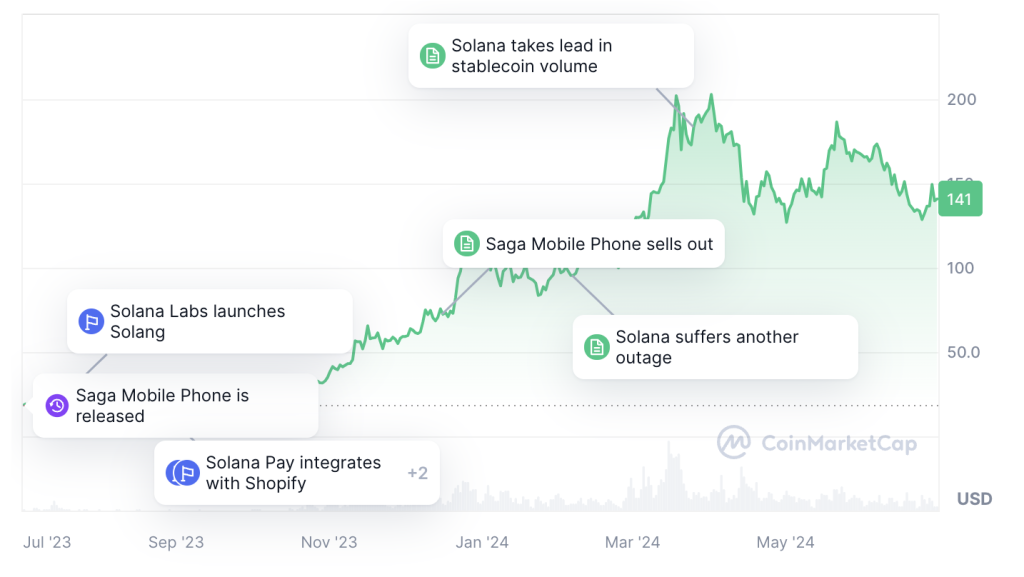
It marks a remarkable final year for Solana, which saw it grow rapidly as a platform for decentralized applications due to its high speed, low costs and good development tools, also seeing the value of the SOL token increase by a whopping 648% .
After Bitcoin, Ethereum and BNB, the token of Binance, Solana is now the fourth largest cryptocurrency in the world, measured in total market value. Judging by the developments, Solana will pass BNB this year and become the third largest cryptocurrency in the world after Bitcoin and Ethereum, excluding stable token USDT (the digital counterpart of the dollar).
SEC vs Metamask
It wasn’t all party time in the world of Web3, as the crypto world likes to call itself these days. On Friday, it was announced that the US securities watchdog SEC is starting a lawsuit against Consensys , best known as the maker of the popular Metamask wallet.
According to the SEC, Consensys is operating Metamask as an unregistered broker. A substantively nonsensical argument, because Metamask provides a technical service where users exchange cryptocurrencies with each other. The SEC's argument would mean that the sale of envelopes is also subject to regulation, because people sometimes put money and sometimes gift cards in them to give or sell to each other.
The SEC’s value should be right to be able to determine, based on meaningful definitions, the difference between when a cryptocurrency is a means of payment, when it is an investment, and when it is a voting card. The difference between a love letter and a death threat is in the content of the text, not in the form it is sent.
President Biden and his sidekick Gary Gensler, head of the SEC, are as smart in the crypto world (sorry, Web3 world) as Don Quixote and Sancho Panza are in the fight against windmills. In a presidential race that seemed hard to predict at least until last week’s debate, it’s also politically inept for Biden to keep taking on Web3 (I’m learning).
The percentage of voters among people who are active with technology and Web3 is high, while few votes can be won by continuing to kick against Web3 in this way. Smart politicians do not make capital issues of subjects that they can at most stumble over and with which they can gain little. In the meantime, Trump appeared as a cheerful guest on a popular technology podcast .
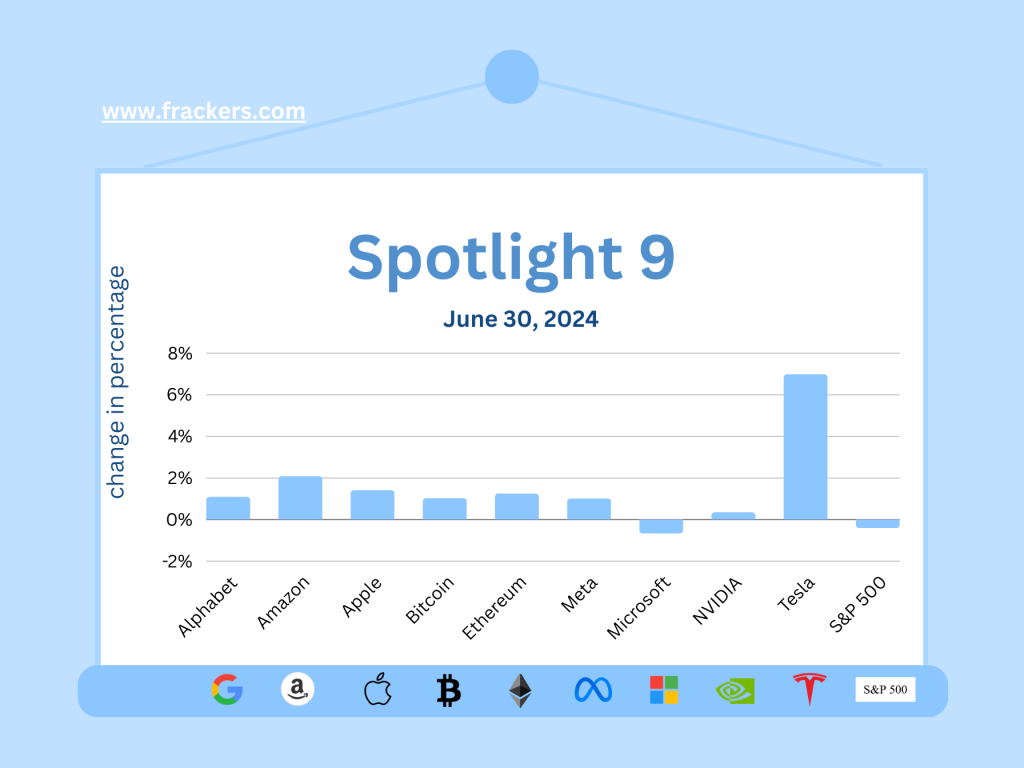
It was also a rather sleepy week on the stock market, with Nvidia recovering slightly from a share price drop due to profit-makers earlier this month. Microsoft is once again the world's most valuable company, Apple number two and Nvidia number three.
As said before : let's look again at the end of the year. Unlike professor Brooks, I hardly ever predict anything, but I dare to predict that Nvidia, unlike Microsoft and Apple, will come up with downright spectacular quarterly figures for the third quarter.
4. Three hundred thousand euros in damages due to incorrect facial recognition
The US city of Detroit is paying $300,000 in damages to a man who was wrongly accused of shoplifting due to the misuse of facial recognition technology.
It won't be the last time that too much trust in complex technology leads to the wrong conclusions. With facial recognition, it is often a problem that people with a color are confused with each other.
iPhone users can test it themselves on their own photos . If there are no dark-skinned people among them, it might be an indication to get out of your own bubble more often.
5 . Electric car battery charges in 4 minutes 37
British startup Nyobolt has charged an electric car battery from 10 to 80 percent in just four minutes and thirty-seven seconds. The breakthrough, demonstrated using a purpose-built concept sports car on a test track, surpasses the current performance of Tesla superchargers, which take around fifteen to twenty minutes for a similar charge.
The question is of course what this technology costs and how quickly the fast chargers will be available en masse. Tesla recently had to significantly scale back its ambitions to install an infrastructure for fast chargers across the United States . The question is therefore with which partners Nyobolt will do the rollout.
6. 'Apple builds cheaper Apple Vision Pro'
The plan was to make a standard version of the Vision, just like the iPhone, and a more expensive Pro line. However, plans seem to have changed and the result seems to be a new Apple Vision for just over half the price, but with a much worse resolution.
Unlike phones, resolution is crucial for a VR device. It is precisely this aspect that was so highly valued when the Vision Pro was introduced. But the device is too expensive and apparently that quality cannot be mass-produced at a lower price for the time being.
Not being plagued by false modesty, for an extensive analysis I would like to refer you to my piece from last May in which I wrote:
“All signs point to the Apple Vision Pro being a flop – a flop by Apple standards. But that’s not a bad thing at all. At least Apple is trying to develop something new again, and that’s better than buying back hundreds of billions of its own shares without any imagination, as in recent years.”
The good news for Apple is that the iPhone 16 does look set to be a sales success. Not just because of a new "capture" button , but because the expected AI features will only work on the iPhone 15 Pro with the A17 Pro chip.
A whopping 270 million iPhone owners haven’t updated theirs in four years, but if they want to use AI, they’ll have to now. And that’s good news for Apple.
7. Bad news for people with a fear of flying
It is not because the media has seen that articles about it are extremely popular and therefore there is a lot of media attention for the phenomenon, it also turns out to be a reality: Clear Air Turbulence (CTA), turbulence in clear weather, is more common than ever .
Last month, one person died and several passengers were seriously injured when a Singapore Airlines plane bounced for a minute . Surprisingly, for once, it wasn't Boeing's fault.
This research from the University of Reading found that severe clear-weather turbulence in the North Atlantic, for example, was 55% more frequent in 2020 than in 1979, 'consistent with the expected effects of climate change.'
8. Marc Andreessen looks back on Mosaic and Netscape
Marc Andreessen and Ben Horowitz, founders of investment firm Andreessen Horowitz (known for Facebook, Airbnb, Instagram, Zoom and many other successful companies), look back on the breakthrough of the internet, when Andreessen co-founded Mosaic (the first internet browser with, how is it possible, pictures!) and Netscape, the company that started the dotcom boom.
The retrospective is particularly interesting because the gentlemen both share many insights that are relevant to anyone working in the field of innovation and technology. This podcast is an absolute must .
Also recommended by me more often: the two books that Ben Horowitz wrote about entrepreneurship. First of all The Hard Thing About Hard Things , about building a startup, with especially sharp analyses about what he did wrong at his company Opsware and what lessons he and the reader can learn from it.
But What You Do Is Who You Are , about how a company can build (or break down) its own culture, is also very much worth reading; even if you don't work at a startup but do value a good corporate culture and a pleasant place to work.
9. Why women need less exercise than men
There is a gender difference, which I have suspected for some time; but this time research has been done on how much exercise we need for a healthy heart and for once it is in favor of women.
A study of four hundred thousand people shows that men need to exercise five hours a week to achieve maximum positive effects for their heart, while women need only two and a half hours a week.
Why men are more likely to have heart attacks at a younger age than women and what we can do to prevent heart failure is clearly explained in this short video from the BBC .
10. Tracer webinars: Wednesday July 3, July 10 and July 17
This is the sixty-first edition of this newsletter and, except for the Christmas period, it has always been published weekly. During the summer period, I will switch to a monthly newsletter, so the next editions will appear on August 4 and September 1. Only in the event of a special event will I send an update in between, if possible.
The real enthusiast ???? doesn't have to miss me all month, because this summer I will present a series of webinars about the Tracer token and the Carrot (carbon removal) smart contract.
The first webinar will be held next Wednesday, July 3 at 12:00 CET, in which Tracer Chief Business Officer Gert-Jan Lasterie will discuss the tokenomics of Tracer and explain why the token still costs $0.75 cents in the current private round and double that, $1.5 cents, in the public sale later in the third quarter. You can register for Wednesday's webinar here .
The next webinar, on Wednesday July 10th at 12pm, with Tracer Chief Technology Officer Philippe Tarbouriech, will focus on the Carrot (carbon removal) smart contract and how the carbon removal credits are tokenized, and then qualified based on 'grade': the duration of CO2 removal. Registration for that webinar on Wednesday July 10th can be done here .
Special webinar: Marketing and PR in Web3
On Wednesday July 17th there will be a webinar about the latest developments in marketing and PR of Web3 projects with a very special guest. I will announce who that is on X and LinkedIn , so follow me there for that information and other smaller updates during the summer.
Michiel Frackers is Chairman of Bluenote and Chairman of Blue City Solutions.
 Follow Marketing Report on LinkedIn
 Subscribe to the Marketing Report Newsletter
 Send us your press releases, columns, interviews…
Join Marketing Report in our LinkedIn Groups