![[Column] Michiel Frackers: Is the end of an independent OpenAI near?](Article Images/Key Persons/michiel-frackers-marketing-report-one.webp)
[Column] Michiel Frackers: Is the end of an independent OpenAI near?
|
This week, several long-standing trends in the technology sector came to the surface more emphatically. First, the growing influence of large technology companies on politics and government, and then the question of whether AI models are economically viable, with even 'life-threatening' market conditions for AI startups such as OpenAI. In the crypto market, it was complete chaos. Big Tech and Political InfluenceThe leaders of technology companies are increasingly trying to gain influence on social and political processes. It is no longer just Elon Musk, who last month, as a South African-born, Canadian-passported, naturalized American, tried to emerge as an expert on German society and openly called for support for the AfD, now Germany's second largest party with 21 percent. Amazon founder Jeff Bezos is suddenly also a political activist. The not-so-left Wall Street Journal is merciless to Bezos , subtly pointing out that Amazon recently coincidentally paid $40 million for an authorized documentary about Melania Trump, three times more than any other offer . The WSJ continues: “There were the flattering tweets Bezos sent celebrating Trump’s victory, and his prominent presence alongside other tech leaders at the inauguration—Zuckerberg, Musk, Apple’s Tim Cook and Google’s Sundar Pichai, among others. Their seats onstage, directly behind Trump and in front of the Cabinet, could be read two ways: as a historic gathering of new economic and technological powerhouses declaring their support for the incoming administration, or as a hostage video of billionaires held captive by a menacing strongman. This week, another shock came when Bezos announced that the opinion pages of the Washington Post (which Bezos bought in 2013, MF) would henceforth be devoted to defending the principles of “personal liberty and free markets.” The shift to the right led to the resignation of David Shipley, the section’s editor in chief. Critics decried the move as an attempt to stifle liberal opposition and criticism of Trump, while others noted that such views are widely represented in other publications. Bezos is now working on his PR by launching singer Katy Perry into space, with Oprah's bestie and his own fiancée , a more original way to test your relationship than Temptation Island. New macho tech bro: Alex KarpNow, enter the formerly media-shy Palantir CEO Alex Karp, who in a new book openly advocates a system in which democratically elected leaders are replaced by an AI-driven bureaucracy. His argument is that AI can make decisions more efficiently than human administrators. It has also rarely been accused of left-wing leanings. Bloomberg was harsh on Karp's book: "A major complaint of the authors of The Technological Republic is that people today are afraid to speak their minds. Too many of us, they argue, give half-hearted, evasive answers when asked questions. We are uncomfortable making moral and aesthetic judgments, they say. I agree, and I'm going to break the taboos. The Technological Republic is a terrible book: poorly written, boring, and—if the ideas can be picked up through the jargon, clichés, and repetitions—full of bad ideas ranging from questionable to objectionable and disturbing. This book is a disaster in both form and content. It paints a dark and depressing picture of the future." No recommendation that will make it onto the back cover of the book, which should be seen primarily as a brochure for Palantir. Big Tech Cries Out for Government InterventionThe founders of Big Tech companies Meta, Amazon and Tesla position themselves as indispensable for economic and social progress and claim that their success is the result of technological and market-oriented superiority. At the same time, Meta is largely responsible for sharing disinformation and sowing social division with click-hungry algorithms, Amazon is the pinnacle of consumerism with a history of dismal employment conditions and Tesla enjoyed no less than 38 billion dollars in government subsidies. According to the Washington Post in an article that dared to express some criticism of Tesla's supposed success based on free market forces. With the impending introduction of Artificial General Intelligence (AGI), technology is playing an increasingly important role in society. While politicians at the end of the last century often sneered at what was often described as nothing more than automation, it is only now that it is understood that the ongoing digitalization of the world is transitioning into AGI systems that, without democratic control, pose the risk that a small number of leaders of technology companies will amass disproportionate power. The interests of Big Tech do not run parallel with societal values such as privacy, democracy and participation. The tech bros think first of the quarterly figures. |
 |
|
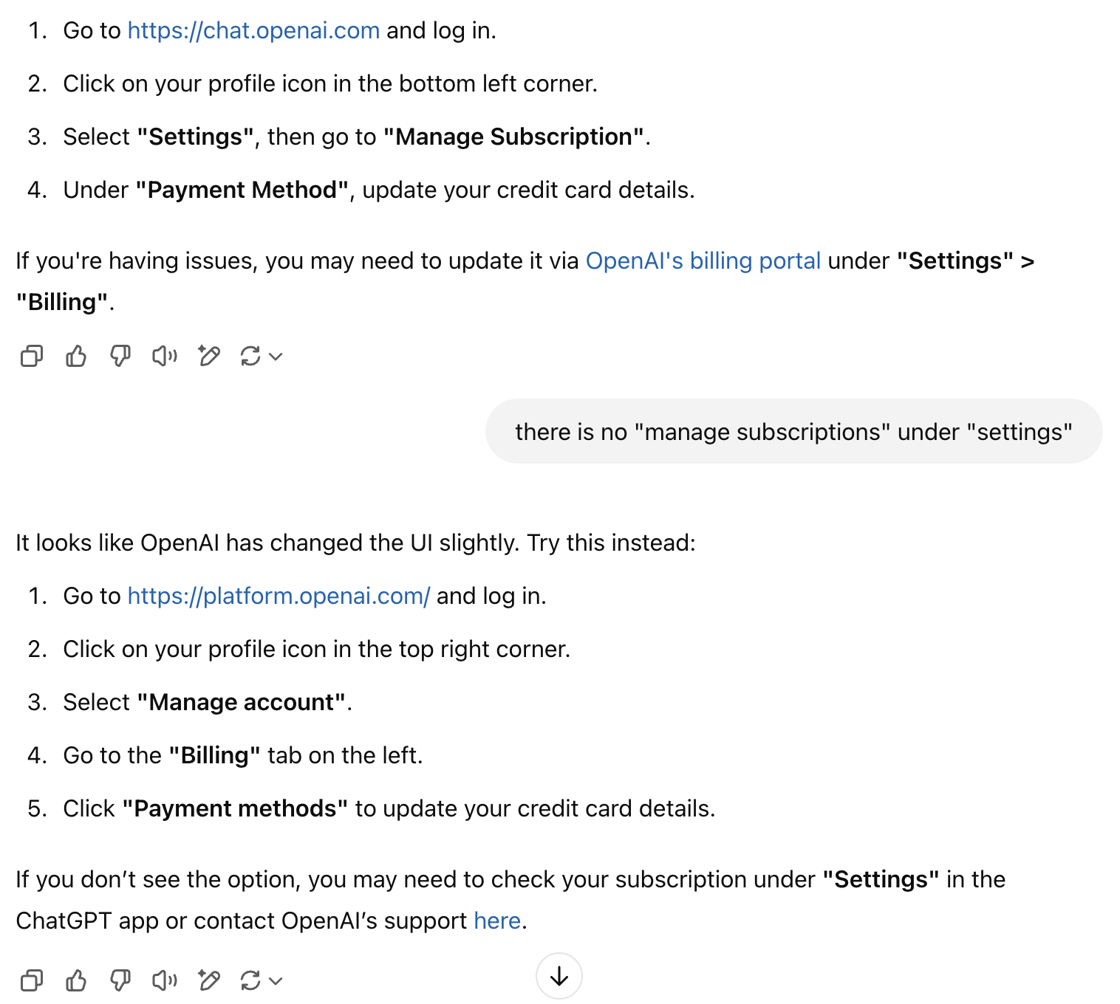
OpenAI's focus is not yet on making revenue. Just try updating your credit card.
The Missing Business Model of AISpeaking of the pressure of quarterly results, there is an ongoing debate within the technology sector about the effectiveness of different business models. A major issue is always whether companies should bundle technologies or offer them as separate products. An example of this is Microsoft’s acquisition of Skype for $8.5 billion, an amount that was probably never recouped due to lack of clarity about the pricing model and lack of integration with MS Office. Om Malik concludes delightfully cynical on the announcement that Microsoft is shutting down Skype: "The demise of Skype is a good lesson in how ineffective middle management can destroy successful acquisitions. I have never met a Skype manager on the Microsoft side who had any imagination. Most were such 'drones' that a red clay brick next to them would look like a work of genius. Microsoft Teams is a terrible product—and I hate using it. In the simplest terms, Teams is the perfect encapsulation of a bureaucratic, outdated, archaic 50-year-old company trying to reinvent itself as a leader in AI.” When the relatively simple product Skype, which already had millions of users worldwide, is so complex to exploit profitably by a giant like Microsoft, it becomes particularly interesting to see whether opaque billion-dollar investments in AI will ever yield the intended return. The quarterly figures of Microsoft, Meta and Amazon are increasingly being scrutinized by analysts for their AI spending. Although these companies are investing tens of billions in AI, Nvidia is the only one to consistently benefit from this trend and it remains unclear whether the Big Tech companies will ever make a profit on their AI investments. Big problems for AI startupsFor leading AI startups, it’s all hands on deck this year. In recent weeks, Grok 3 (from Elon Musk’s x.ai), Claude 3.7 Sonnet (Anthropic) and ChatGPT 4.5 (OpenAI) have been launched. Analysis suggests there are doubts about the quality and efficiency of this latest generation of AI applications. “It’s a lemon ,” headlines Ars Technica about ChatGPT-4.5. Gary Marcus points out several problems with OpenAI:
Ethan Mollick, on the other hand, remains positive about progress in AI: "The intelligence of AI models is increasing, and the costs are coming down." But people like Mollick are now in the minority among financiers. The problem for AI startups like Elon Musk’s X.AI, Sam Altman’s OpenAI, and competitors like Anthropic (with Claude) and Mistral, is the growing doubt about the true technological progress relative to the rising development and operating costs. Investors are increasingly questioning whether AI companies can be profitable in the long run. The debate is no longer about the conviction of AI proponents, who regard AI development almost as a faith, or about the objections of non-believers, let me call them "AI theists", but about economic reality. The key question is not whether AI can continue to grow and fundamentally improve, but whether this can be done profitably. In the investment world, there are serious doubts about two things:
For OpenAI, this is an urgent problem. Companies like Microsoft, Meta, Oracle and Salesforce invest tens of billions in AI every year, but can absorb losses with profits from other activities. OpenAI, on the other hand, is completely dependent on AI and remains heavily loss-making. Legendary investor Vinod Khosla, an early backer of OpenAI among other things, openly says that he expects most investments in AI to be loss-making. Of course, that doesn’t apply to his own investment in OpenAI, because he was so early in the game that any sale of OpenAI shares will be a hit for Khosla. |
 |
|
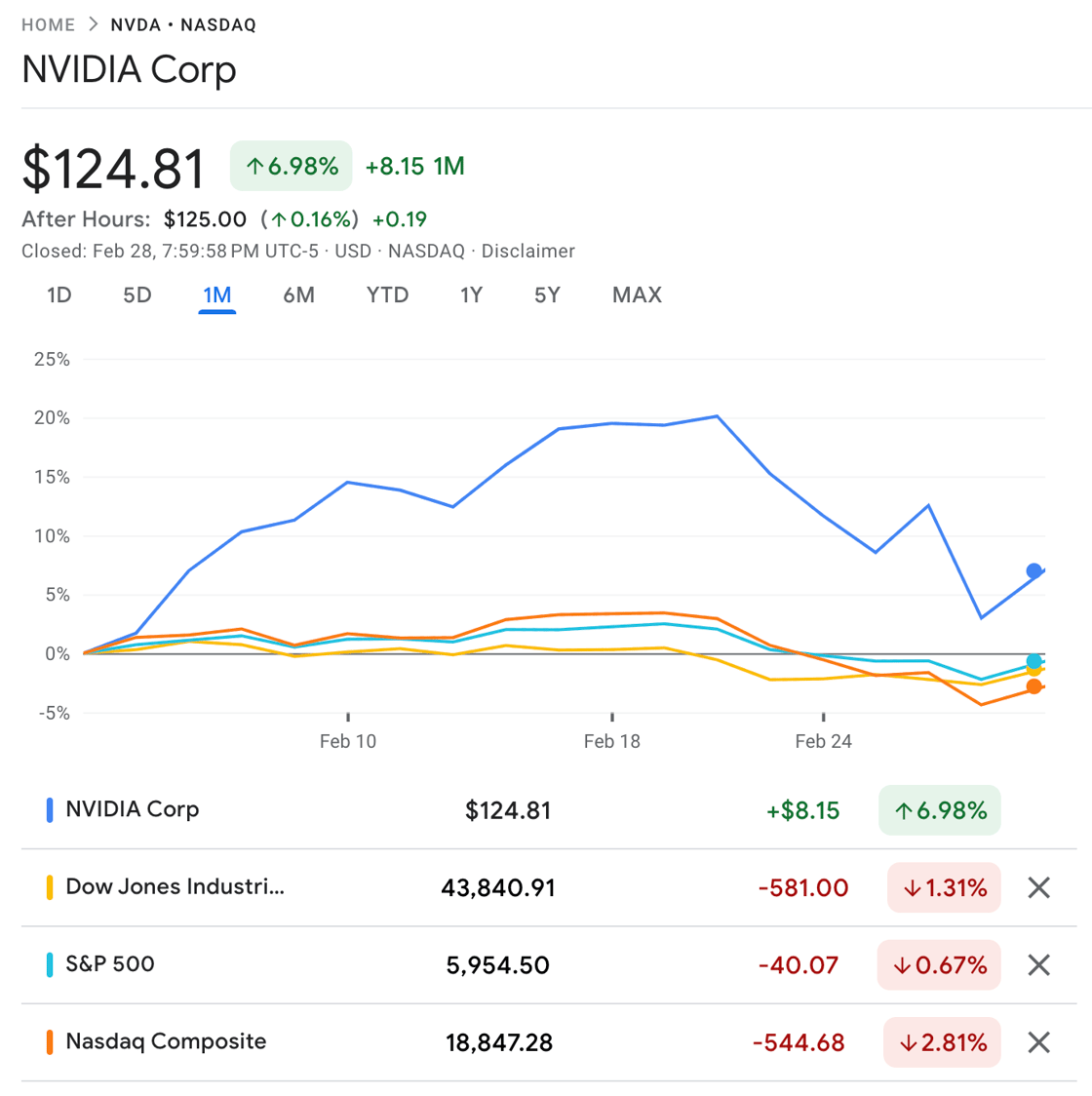
The "disaster month" for Nvidia, compared to the Dow, S&P and Nasdaq Composite... Nvidia is benefiting from the confidence within Big Tech that increasingly powerful and expensive chips are the solution. The company once again achieved record results, although profit margins are decreasing. The gross margin nevertheless remained at an impressive 72 percent. It is therefore no surprise that Nvidia rose again 4 percent on Friday and still ended the month of February with a profit of 7 percent, while the major stock indices were actually recording losses . Barron's therefore half-jokingly called Nvidia a value stock . DeepSeek with bad news for OpenAIOf all companies, DeepSeek, OpenAI's much-maligned Chinese competitor, claimed yesterday on X to have a much more efficient cost structure: "Our cost-benefit ratio is 545 percent." Later, a more extensive explanation followed on GitHub, to which Techcrunch sharply concluded : "The company (DeepSeek, MF) wrote that if it looked at the usage of its V3 and R1 models over a 24-hour period, and if all of that usage had been billed at the R1 prices, DeepSeek would have already generated $562,027 in daily revenue. At the same time, the cost of leasing the necessary GPUs (graphics processing units) would have been only $87,072. The company admitted that actual revenue is significantly lower for several reasons, including night-time discounts, lower prices for V3 and the fact that only a portion of services are monetized, while web and app access remains free. If the app and website were not free and other discounts did not exist, usage would likely be much lower. These calculations therefore seem largely speculative—more an indication of potential future profit margins than a realistic representation of DeepSeek’s current financial situation. Yet the company shares these figures amid broader discussions about the costs and potential profitability of AI.” With that, Techcrunch hits the nail on the head. Any investor gets the idea that DeepSeek has a much greater chance of becoming profitable than OpenAI, which no longer has a substantial technological lead, referred to in Silicon Valley as a "moat", and also does not have the financial resources needed to eliminate the competition. Think of how, for example, Mark Zuckerberg once bought the fast-growing competitor Instagram with Meta. The coming months will be crucial for OpenAI. The company is in dire need of capital. It is now at the mercy of Softbank’s Masayoshi Son, who is already raising $16 billion in loans , a sign that the sector’s biggest financiers are cautious. Even if all the money Softbank is now raising in loans were to go into OpenAI, which is doubtful, the question is how far OpenAI will get with that money. Savior from Abu Dhabi or a mirage?Another potential investor is Tahnoon bin Zayed al Nahyan, an influential Abu Dhabi financier irreverently dubbed the Spy Sheikh by the Wall Street Journal . As manager of several Abu Dhabi sovereign wealth funds, including MGX, he can determine from his desert castle whether Sam Altman's castles in the sky ever become reality. The question now is whether OpenAI can survive another year without quick funding. If a billion-dollar injection doesn’t come soon, a takeover is looming. Microsoft already owns 49 percent of the shares, is the leading provider of cloud infrastructure and can cough up $100 billion to buy out existing OpenAI shareholders. That’s a very different reality for OpenAI CEO Sam Altman than a few months ago, when he thought he could raise $30 billion for just 10 percent of the shares. |
 |
|
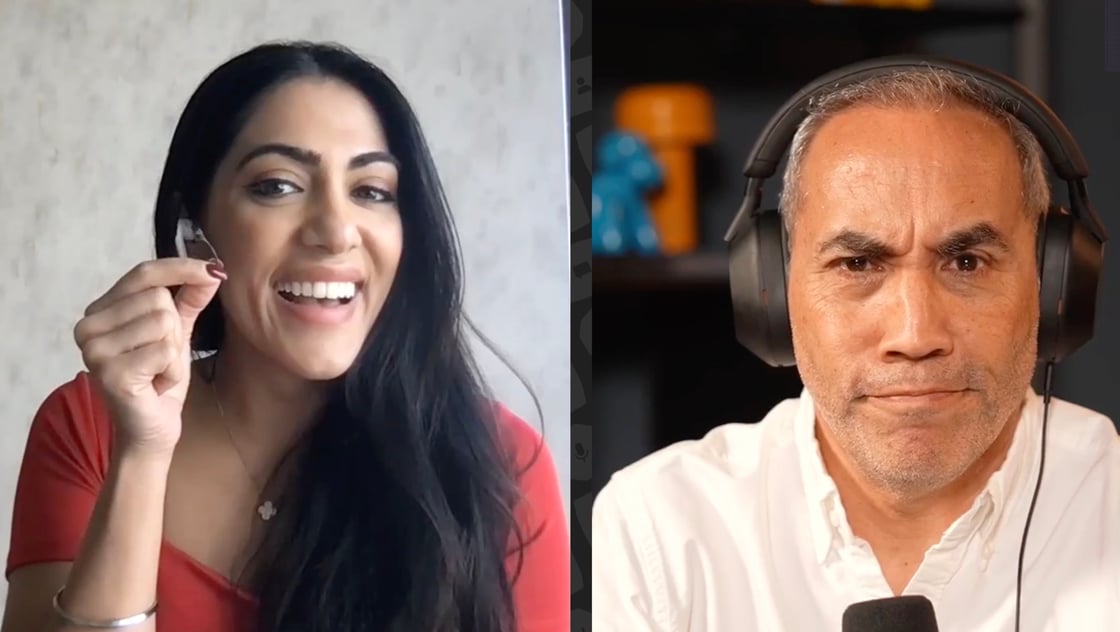
Dr. Sachdev lost the bet on price predictions, but still bought crypto. Bloodbath in the crypto marketIn episode 5 of the NFA Podcast (for Nish, Frackers and Anyone Else, and of course for Not Financial Advice) Nish eats an Indian green chili because she lost the bet on the market going up or down. She was dressed in red to symbolize the bloodbath in the crypto market. In more relevant news, we discussed the drop in new token launches on Pumpfun, BlackRock’s Bitcoin sales, and the SEC’s ruling that meme coins are not securities. Normally, that would be positive news for the speculative crypto market, but it didn’t matter last week: pretty much everything plummeted. The Bybit hack, which was linked to North Korean attackers, was also discussed extensively and showed vulnerabilities in multi-signature transactions. Finally, we discussed whether Bitcoin will reach an all-time high this year and how its correlation with traditional markets is developing. We agreed, which is not the intention of the format. Episode 5 of the NFA Podcast “Crypto bloodbath, the Bybit hack fall out and will Bitcoin “go rogue” to hit an ATH?” is available to listen to now or watch here on YouTube and also here on Spotify . You can subscribe to the special NFA Podcast newsletter, which will keep you up to date on every new episode, here via LinkedIn . Thanks for your interest and see you next week! |
 Follow Marketing Report on LinkedIn
 Subscribe to the Marketing Report Newsletter
 Send us your press releases, columns, interviews…
Join Marketing Report in our LinkedIn Groups